

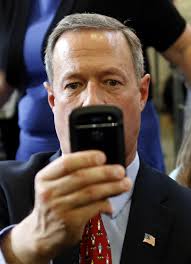
Could-be presidential candidate Martin O’Malley is getting a bit of bandwidth for telling CNN that “WiFi is a human right.” In turn, the people of the Internet exercised their right to respond in kind by poking fun and looking at the Maryland data behind the governor’s grandstanding.
In a profile titled “The Hardest-Working Man in Democratic Politics,” the O’Malley WiFi remark was lumped in with a host of sweeping generalizations about the youths:
Younger people are choosing to live in cities. They realize that connections to each other are making us better. That WiFi is a human right. That proximity is important to entrepreneurship, access to capital and talent and diversity. There is an opportunity there for us as a nation to embrace that new perspective.
Being fairly familiar with WiFi, the Internet echo chamber seized on the phrase. New York Magazine couldn’t resist creating their own top-10 list of other things that should be human rights, like extra guacamole.
But if O’Malley is going to make the claim a piece of any future presidential run, he’ll need more than chip dip to back it up. In addition to snark, said Internet connection also provides access to all sorts of research available about Internet availability in the state that O’Malley now governs. Turns out, WiFi is still a privilege for most of O’Malley’s constituents.
A recent move to put free WiFi in Inner Harbor was the culmination of a planning process that started during O’Malley’s term, so that’s a point in the governor’s column. Perhaps underscoring how hard it is to put free WiFi in place, however, we’ll note that it took more than 10 years to get that connection up and running.
With his statement, O’Malley’s dream appears to be giving free WiFi to the places that don’t happen to have tourist attractions. So, how is the rest of the state he governs fairing?
According to The Washington Post, Internet access outside the home is growing at a faster rate in Maryland than the national average. In general, the state’s connectivity is also growing at a rate that outpaces the country.
The Post’s Philip Bump acknowledges that we’re making progress, but notes there are still likely about 300,000 Marylanders who lack access to the Web. Along with his sweeping declarations, perhaps O’Malley could work to give them some before his term expires.


