

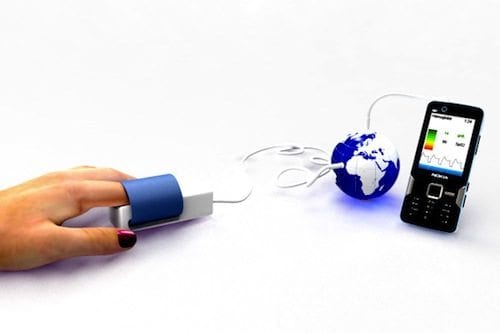
Earlier this month, Johns Hopkins sophomore George Chen flew to Seattle for an event hosted by the Saving Lives at Birth: A Grand Challenge for Development. He was there to show off an invention he’d developed (along with faculty adviser Soumyadipta Acharya and fellow students Noah Greenbaum and Justin Rubin) that uses cell phones to test for anemia. Though the event was hosted by deep-pocket global health organizations (USAID; the Gates Foundation), Chen didn’t really expect to come away with anything more than exposure. He definitely didn’t expect to walk away with a quarter million dollars in funding — but that’s exactly what happened. “When we thought about the big-name corporations and nonprofit groups we were competing against, we were amazed and surprised to find out that our team had won,” Chen told the Hopkins Gazette.
The device, which is called HemoGlobe, started out as a project for Acharya’s biomedical engineering design team class. They knew that anemia, which occurs when a person has too few healthy red blood cells, results in 100,000 maternal deaths and 600,000 newborn deaths each year. One big obstacle to treating the disease is the difficulty of making diagnoses in rural areas.
“The team members realized that every community health worker already carries a powerful computer in their pocket—their cellphone,” Acharya said. “So we didn’t have to build a computer for our screening device, and we didn’t have to build a display. Our low-cost device will use the existing cellphones of health workers to estimate and report hemoglobin levels.” And each system shouldn’t cost more than $10 to $20 to produce.
The team plans to use the $250,000 seed grant to refine the system’s technology, and to field test it in Kenya next year. “The first year we just focused on proving that the technology worked,” Greenbaum said. “Now, we have a greater challenge: to prove that it can have a real impact by detecting anemia and making sure the mothers get the care they need.” Not bad for a crew of undergrads.

