

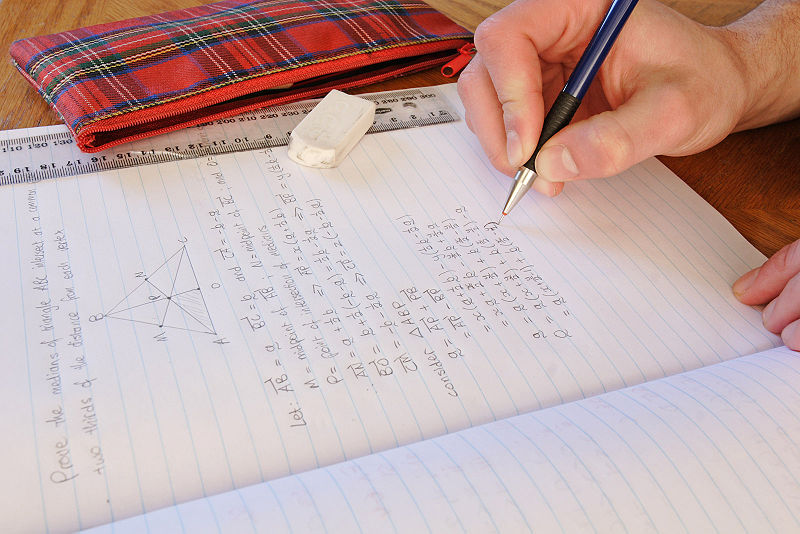
It was a picture-perfect evening. The humidity had finally dissipated, leaving us with air that could almost be called crisp. To the west, the sky was turning shades of orange and gold as the sun began its descent. Somewhere nearby, little kids laughed and screamed as they played chase before their parents chased them inside for the night.
Inside, my 11-year-old daughter experienced none of it. She sat, hunched over at the kitchen counter, school books splayed in front of her, her hand holding up her head. It wasn’t long before her fatigue and frustration gave way to whimpering and a full-on meltdown—ostensibly over a single homework assignment but more likely due to the breaking point brought on by sheer exhaustion that comes after a long day of school followed by a seemingly longer evening of homework. Ah, welcome to the start of another school year.
Most moms I know wear big, Cheshire-cat style grins on the first day of school. I’m no exception. We’re so happy to have our kids return to school, with the much-needed structure it provides to children who, by the end of the summer, no longer seem to know what to do with themselves besides pick fights with their siblings and complain about how bored they are. But that feel-good vibe wears off shortly after heavy backpacks come home bursting with homework.
I am convinced that many families suffer through homework hell in silence, perhaps thinking that by acknowledging the reign of terror in their homes that homework provokes they will somehow be revealing their own deficits. But in recent years, homework has become a hot topic among educational researchers. And as the mainstream media increases its coverage on the subject—especially regarding the mixed outcomes of research on homework’s value—some area independent schools have begun to re-evaluate their homework philosophy and practices. Others stand by theirs, reporting that existing practices either get buy-in from parents or are driven by parents’ insistence of a hearty homework haul. I’m not sure who those parents are. Because the ones who spoke to me—on the condition of anonymity, incidentally—spoke of homework in a different light altogether.
“It’s crying all the time. Lots of crying,” said a Baltimore resident and mom of two I’ll call Marnie Smith, when I asked her about the effect of homework on her home front.
While she doesn’t dismiss the value of homework altogether, Smith said she doesn’t believe it’s always administered in the most judicious way. “I still think there should be homework. But I don’t think it needs to be excessive, or homework for homework’s sake,” she said.
When Smith complained to her daughter’s first grade teacher about the copious amounts of ditto sheets that came home nightly, she was met with a terse response. “She told me to rearrange my priorities,” Smith said.
Some schools say they take a different, more inclusive, approach. “We’re in it together. We’re not dogmatic. We’re trying to be sensitive to the needs of families. We have to balance that with what we know [about homework] based on the scientific literature,” said Andrew Taylor, head of the lower school at St. Paul’s School in Baltimore.
Indeed, several studies in recent years have attempted to measure the benefits of homework. As is the nature of most scientific studies, those on homework have looked mainly at quantifiable data; in this case, the link between the amount of homework coming home and subsequent test scores. A 2012 study by the Australian Institute of Family Studies concluded that homework offers elementary- and middle-school aged students little to no advantage when it comes to test scores, with the caveat that small amounts of homework at any grade level can improve students’ ability to be self-directed. A study led by Duke psychologist Harris Cooper found that, in younger students, homework had no effect on test scores; in older students, homework appeared to have a positive effect on grades, but no impact on test scores.
Cooper doesn’t think that all homework is evil. He supports the 10-minute rule, whereby first graders get 10 minutes of homework nightly, and that amount increases by 10-minute increments with each grade level. Cognizant of recent research on the topic and the competing interests vying for families’ attention—like piano lessons and soccer practice—St. Paul’s Taylor says that in recent years he’s made a concerted effort to stick to the 10-minute rule for his students. And, he emphasizes, students should be able to complete homework independently.
“I often wonder how productive a child is going to be when she’s spent an hour sobbing at the kitchen table, mom and dad are yelling, and everyone’s in a heightened state of emotion. No one learns well in that type of environment,” Taylor said.
Ed Trusty, head of the lower school at the Calvert School, concurs with Taylor’s view on homework—to an extent. “We generally assign homework that children can complete independently. We don’t want our homework assignments to be overwhelming,” Trusty said. But he also points out that the school responds to the demands of its clientele.
“Our clientele expect us to have homework. They often ask us if they can have more. They expect and equate it with rigor,” Trusty said. “None of the parents has ever asked us why we give so much homework.”
That’s one side of the spectrum. Then there are Montessori schools, which adhere to the philosophy that education is a self-constructing process and that homework has no place in it, especially for young children. Nancy Anselm is the educational and admissions director at Montessori International Children’s House in Annapolis. The school, which educates children ages 2 through 12, emphasizes at-home chores, family time, and pleasure reading over traditional homework. Asked how parents respond to this philosophy, Anselm said: “They are so relieved. I have never had a parent tell us to ramp it up.”
That might sound like heaven to Towson mom Anne Jones (not her real name), who bemoans her family’s attempt to juggle her two sons’ sports and homework schedules during the school year. “During baseball season, it’s a nightmare. Everyone’s in a rush,” she said. Rather than trying to squeeze in homework between school and baseball games, ponders Jones, “Maybe it would be more important to just sit down and have a meal together.”
In our go-go-go society, eating dinner with your kids during the week may sound like a novel idea. Having kids do the dishes afterwards sounds even more archaic, thanks to the omnipresent, overwhelming chore of homework that awaits children nightly. “When I was growing up I had to do the dishes every night. My children are never expected to do so because after athletics and dinner, they face hours of homework and saddling them with the dishes just means they go to bed that much later,” said one Baltimore County mother of four.
So then, does homework replace traditional household chores? And, if so, does that mean our children will grow up able to churn out tasks for employers, like writing reports and completing spreadsheets, but wholly unprepared as adults to take out the trash, wash the dishes, or mow the lawn?
It’s quite possible. Because, in spite of research that reveals zero to small gains from homework, especially prior to high school, the majority of schools that consider themselves “academically rigorous” continue to pile on the homework—in spite of, or because of, parental input.

